So, I finally got a chance to try a lifes dream: Big game fishing in one of the worlds best areas for Blue Marlin - the coast of Ghana.
We chartered the ULTRA-PROFESSIONAL and very luxuriously equipped boat with the catchy name: "The Hooker"... It was truly a pleasure to work with these guys (no, they are not giving me commision for this post), especially the way they knew their fishing grounds. Oh, and the service included always ice cold beers as well as good food and plenty of snacks :)
Anyway, to get to the fishing bit, we had two hits during the day, the first one being on my rod (unfortunately putting me at the back of the cue), and I got the pleasure of fighting a small Wahoo (25pounds) - a fish said to be the fastest in the ocean. On gear as heavy as this, there wasn't really much fight, but it was a good warm-up, of what was to come next.
The second hit brought the boat to life after a few hours of quiet cruising without any action. The crew spottet a Marlin hunting close to the surface, and brougt us close. It got attracted to our lures ("extra" lures without hooks that trails the boat closely to bring in the big fish), and after giving us a brilliant view of the dorsal fin (about the size of a great white's) as it was hunting behind the boat. A few seconds later...the hit! When a fish like this takes the lure, the reel goes on overdrive, whilst the fish pulls it for about 200 yards in about 4 secs. It was fantastick to hear the "wrrrr" from the 125 pound (!) line, as the fish pulled.
James got in the chair and started the fight...
It didn't take as long as I expected, but it was great whilst it lasted. When the fish finally came along side, the crew prepared to release the fish. The catch-and-release principle means that only record-size fish are killed and brought in after the day. A great principle in my view, in order to protect the fish. It also means, however, that a lot of the fish get away, when you try to pull them in and along-side ship for a measurement. This was also, what happened to James, but at least it was after he had had the full fight :) I attach the finale, just when the fish is released - unfortunately without photo, but you can still see the huge shape, when the marlin pulls away from the boat. The guy handling the line - Frank - has participated in the capture of more than 2000 (!) marlins, and his estimate was 600 pound plus... What a day...
P.S.: I thought it prudent to add that same James managed to get out again some weeks later...and this time he got another 600-pounder all the way to the side of the boat - have a look:
Well, this time I think I might be pushing my readers’ patience when it comes to updating my blog. My daily schedule rarely lets me write these day-to-day posts, that normally characterize a blog (and neither does my internet-connection either), which is why these long updates arrive at a less than frequent pace. Some day, it would be nice to have sufficient time – or energy – to be a properly active blogger, but that day lies a bit far ahead in my case, I’m afraid…
- Well, all apologies aside, let me try to make up for several weeks (months?) of missing activity…
As I have mentioned before, I had the pleasure of visiting friends for almost 3 weeks before Xmas. It was truly a joy spending time with some old friends again, not just for the socialising (although that was very much needed) but also because I find, that one enjoys the great experiences down here a lot more, when one has someone to share them with. Thus, apart from daytrips in Ouaga, Banfora and the likes, we also enjoyed an extended weekend trip in Mali with visits to Timbuktu, Mopi, Djenne and San as well as some time in the Malian capital, Bamako. Since I had to work through the whole stay of my friends, they also had quite a bit of time to themselves, which they bravely used to go exploring on their own – they (inadvertently, I guess) even visited the poorest and oldest quarter in Bobo – the neighbourhood with the worst reputation in this part of BF, where very few white guests normally go – and they did it on foot! Anyway, the fact that nothing happened, except for the unavoidable cries of “Tuab, tuab” (which means “whites, whites” in one of the local languages), just underlines that Burkina Faso in general – and Bobo in particular – has to take the price as the most peaceful place in West Africa. The general mentality is simply so very relaxed and pleasant, that one cannot help admiring it – because a lot of these people really don’t have a lot going their way in life.
Going on the big one in Mali
The round-trip in Mali was quite an experience. I have already posted quite a few photos on my new online photo album – http://picasaweb.google.dk/Rejseneger - from the different places we visited, but I think the trip deserves a few comments in writing as well. When I first booked the trip long before my friends had even arrived, it was not without a certain scepticism towards paying a lot of money (and quite a bit of that in advance) to a – to me – unknown Malian for a trip that amongst other things involved 2 domestic flights, 2 walks through the poorest neighbourhoods in Mali as well as a camel-ride on the border of the Sahara. All of my concerns proved to be falsely placed, though, because what we experienced was well worth the expensive ticked price – well worth it indeed. After a night or two in Bamako – where I had to go for work anyway – that included outings to see the city from above, the presidents little “hut”, the artisans market (especially the carvings and the bronze there is exquisite – my mate Torben got his hands on two absolute masterpieces), my favourite bar (where a double whisky costs 15us, so we stuck to the beers) as well as a crossing of the Niger river at surface-level on old concrete blocks, we were ready to take on the adventure of the legendary Timbuktu – or Tomboctu, as it’s called in the French-speaking Mali.
This town is nothing less than amazing. Placed as close to the middle of nowhere as one can imagine, this city has such a long and incredible history, that one can truly feel the weight of the ages on ones shoulders, as one strolls down the cobbled streets in the city centre. Timbuktu used to be amongst the intellectual centres of the world before a jealous Moroccan king decided to sack the city and kidnap all the professors and scholars who worked there to bring them back to Morocco. Literally hundreds of thousands of students used to take one of the two equally perilous journeys either through the Sahara on the back of a camel or by the grandiose Niger river by tiny boats to go and study there. The city was mentioned in so many old documents and surrounded by such mystery, that for many years, the National Geographic Society in London had a price of ten thousand pounds in gold for the man who could prove that the city of Timbuktu actually existed!!! After arriving there we had a very interesting guided tour through the old town seeing markets, mosques, historical points of interests etc. A great experience – I mean – if one has a bit of a travel-gene in ones body, isn’t it amongst the greats to be able to say that one has been to Timbuktu?! When I become an old toothless grandfather, I will be telling my grand-kids about it, that’s for sure!
An ‘excuse’ owed to an unknown association
Before taking my story further, I apparently have to issue an official excuse to DDF… If that name doesn’t ring a bell, I can tell you the abbreviation stands for ‘Dansk Donaldist Forening’ – Danish Donaldist Association/Union. If you, dear reader, aren’t very confused by now, I’d be surprised. I know I was… DDF is a group of people who apparently enjoy the wonders of Donald Duck to near-religious extremes. The whole, bizarre story took its beginning when I ‘Google’d’ the name ‘Rejseneger’ – just to check its originality. Apart from my blog appearing on the list of hits, to my great surprise I found a mention of my site as a part of a grand discussion on DDFs webpage. Of course I had to check it out, and it has apparently greatly offended members of this – sorry guys – very nerdy union, that I in a previous log-entry have mentioned, that “Timbuktu lies in Mali in stead of in the (fictional) country ‘Langtbortistan’”. I never, ever thought, that people would spend their time criticising something as far out as correct usage of fictional geography – much less getting sufficiently agitated as to be calling me an idiot for such a ‘horrible’ mistake. Well, not mentioning the fact that I think the editorial freedom of blogs should be very big indeed, I shall happily give my excuses for having the before mentioned remark taken so insanely literal and serious… “Sorry..!” Should you wish to see this insanity for yourself, the link is: Http://ddfr.dk/forum/viewtopic.php?pid=17505#p17505
As a postscript I have to mention that the initial post in this string mentioned that I have been published in something as famous as “Herning Folkeblad” (a tiny newspaper that I have never even seen a copy of in my life). I don’t know what is worse; Criticising people for not knowing their IMAGINARY AND FICTIOUS places’ proper geographical position, falsely accusing someone of having published this in an almost unknown newspaper or taking comics religiously serious? I leave that judgement to you, dear reader, and I hope that this will someday hit the website of DDF as well. If nothing else, I promise you, that I had the laugh of the week when I discovered this
The Sahara seen from the back of a camel.
So, after this short excuse, let’s get back to what this blog is all about – great experiences on an equally great continent! After an incredibly interesting day walking through Timbuktu – including a visit to the house of the first white man ever to reach the city (who was unfortunately beheaded by the local Touareg-people, so he never got his gold) and a lunch with plenty of sand in it at the local market (it is said, that if bread in Timbuktu isn’t crunching with sand, it’s not properly prepared), we were ready to take a late afternoon ride out into the outskirts of the Sahara by camel… Great authentic experience – right up until the cell-phone of one of our camel-guides rang! Amazing to have such a clash of new and old, I remembered thinking. The people there live in huts made from braided straw or patched camel hides depending on their financial means as they have for centuries, but at the same time, the local cell phone antenna mounted in the centre of Timbuktu provides ample coverage for at least an hour’s camel-ride into the desert. A bizarre experience in many ways. When we reached the small settlement we were there to visit and share some tea at (I believe I have covered the Malians’ addiction to tea in a previous post on this blog), the circus started. Many years ago, the Touareg people lived as kings of the desert, keeping a whole tribe as their slaves (they are called the Bella and in spite of their status as free people today, they still live in the most extreme degree of poverty), and making big profits on transporting salt in great caravans travelling by night across the Sahara. I believe it must be this history, which has given the Touareg their image as the “proud men of the desert” that one sees pictured in both movies and books aplenty – VW has even released a car-model called Touareg, I believe. This very glorified image deserves heavy revision today, though. Here we have a people, which used to make a living by either crossing the Sahara, burning or robbing villages (to ensure a plentiful supply of slaves) or just simply breeding and selling camels. Today, Maersk Line can put a container of salt in Timbuktu in a matter of days and at a fraction of the cost of a trip on the back of a camel, and slavery has thankfully been prohibited even in Mali. This leaves this ‘proud’ people in a position where they have to adapt to changes, and this is something they in my view are extremely poor at. Apparently it is – according to traditional Touareg beliefs - unworthy for a man to work, except if one does camel caravans, slaving or traditional handicrafts. Since the 2 first options don’t exist anymore, the third option – along with begging, which apparently is a perfectly fine way of making a living – seems to be the only way these people try to survive today. There is literally NOTHING left of this once ‘proud’ culture in my humble opinion. They are – and I’m sorry for the harshness of this wording – reduced to a people of peddlers and beggars. Whenever you meet a Touareg in West Africa today, you’d better start saying ‘no’ right away, unless you want to end up with a worthless piece of ‘silver’ jewellery or an even more useless sabre made of ’real’ iron… The village we visited consisted of kids trying to get in front of our cameras only to demand money for the photo-op and then plenty of eager salesmen who wanted to fill our pockets with ridiculously poor trinkets of questionable value. Some of the traditional art of the Touareg is actually very beautiful, but what these guys were selling was frankly speaking just junk. At least the tea was good, and the sunset beautiful… By the way, if you try to ride a camel the way one rides a horse at a trot, it can result in heavy blistering in places I really would prefer to leave unmentioned in this post…
Mopti and Djenne!
After a reasonable meal at the hotel in Timbuktu (although Torben kept longingly mentioning the wonderful vegetable soup his girlfriend makes him) and a good nights sleep, we were transported (at break-neck speed I must add) to the airport and our second flight with the wonderful national Malian airways. They proved to be a big surprise to me, I must say. The other local flights I have taken down here have left me with fear bordering phobia against flying in WAF. I promise you, dear reader, that the planes still in operation down here wouldn’t be allowed to leave the runway – much less the hangar – in any western country. They are old, worn and in a horrible state of maintenance, they most often only fly with one pilot (allegedly the one in Ghana has a drinking problem too, to make matters worse) and there is quite a bit of turbulence over the West African continent. All in all a wonderful combination that normally makes me do a pope-imitation every time I successfully survive a flight down here. All of this being said, however, the Malian airline proved to be a very pleasant experience. The plane was new, apparently in good shape and there were two (2!) guys in the cockpit! The flights are low altitude flights, so the views were amazing, flying over the big deltas and green areas bordering the ever impressive river Niger. After having gotten our luggage in no time (another positive surprise), we entered what must be considered to be one of the smallest airports in the world, where another guide was waiting with a 4x4 to drive us into Mopti town. The entry into Mopti is impressive – the road crosses a big, dammed (no, not damned!) delta, where you have green farmland on one side and a big lake on the other. It is also where you can experience a Mopti carwash! They have a ramp down into the water, and they simply back the vehicles down it until they are parked out in the water where the hand-washing begins! An interesting sight, I must say.
We started the day with a long walk through Mopti, starting at the central Mosque in town, and then walking through poorer and poorer neighbourhoods for what seemed like hours. When you are a tourist, it’s sometimes quite hard to be left alone – and much less be allowed to take photos – but since the tour was guided, it proved to be a very easygoing way of experiencing the town. The guide ensured us almost total freedom during the tour, and he was quick to tell us if there was anything we couldn’t do. We saw markets, narrow alleys, open sewers and a multitude of welcoming people – constantly chanting the now much known ‘tuab, tuab’. Fortunately, the guide taught us to reply in fashion by shouting ‘frarafin, farafin’ – meaning ‘Africans, Africans’ – which resulted in a lot of laughter and smiles.
A sight with a huge impact
The part of the whole trip, that I think had the biggest impact not only on my visiting friends but on me as well, was when we finally reached the poorest quarter of Mopti, home of the before mentioned Bella tribe – the former slaves of the Touareg. After having seen continuously poorer and poorer neighbourhoods, we thought the tour was coming to its conclusion as the open sewer ended at a road crossing. We were very surprised to see that this was not the case at all… After crossing the road, we descended into what must be the very extremes of human poverty. The now “free” tribe of the Bellas in Mopti, today still regarded as holding the lowest position in the social hierarchy, now try to survive on the remains and wastes from the city. I have seen poverty in many forms on my different travels, but this place takes the ‘price’. Torben took several photos and a bit of film as well – I will see if he agrees to a posting of it here – it is needed, because words have a hard time describing what we saw at this place. The luckiest had what could pass for a hut, whilst the poorest simply slept on the ground in the midst of waste, sewage and animal manure. Kids with big bellies were playing in the – pardon my French – shit, and the whole place had an eerie atmosphere of despair and misery.
Torben let me post the video. "Enjoy":
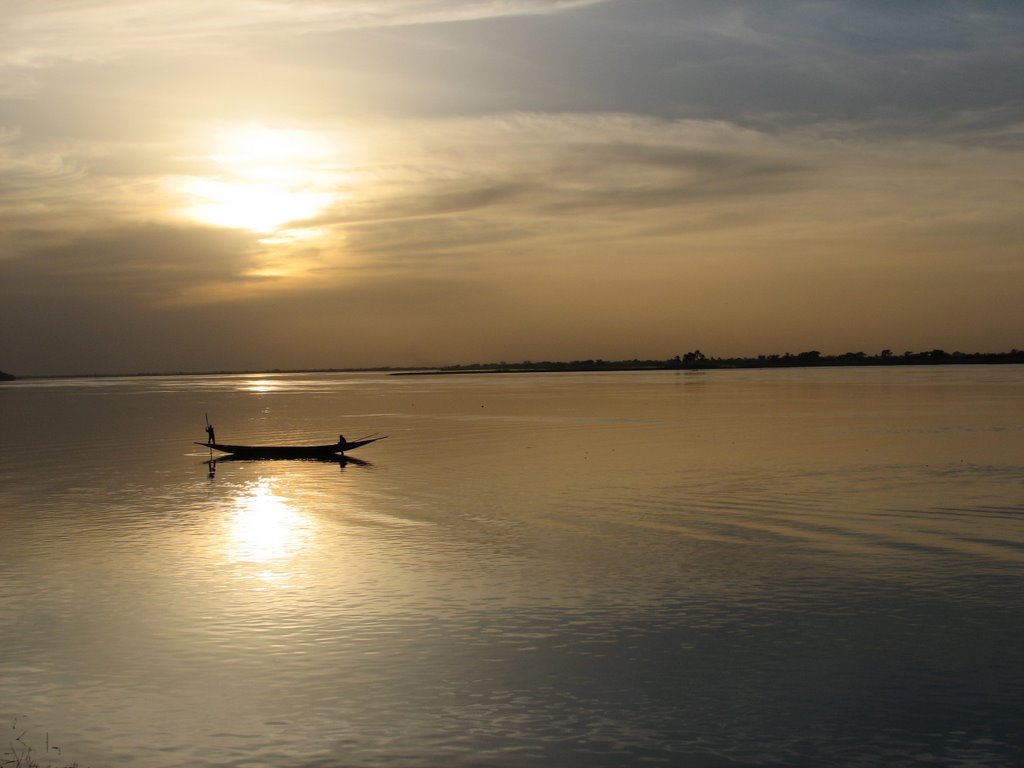
After this, the trip led us to a tour of the port – Mopti’s business core – where longtail-boats much like the ones seen in the far east were aplenty in all different sizes. They all held a multitude of people, however, and even the tiniest ones apparently served as the only home for the families on board. They live their entire life on the river and only come to shore to sell their excess catches and to by the few necessities the river cannot provide them. The whole port has a seething, bustling atmosphere and is a great experience to see. We were all exhausted now, physically but especially mentally, so we had to decline an offer of lunch at the port in order to go to the hotel and rest. Particularly the walk through the Bella-neighbourhood weighed like a tonne on the mental scale, so a few hours were spent resting and discussing the sights of the day – it was great having friends there to share the experience with – because this day is not one easily forgotten. The afternoon and evening was passed sailing on the Niger and its tributary – where Kasper found out, that he needs to have kids (and soon, too!) when a small girl instantly fell in love with him during a visit to one of the many islands in the Niger-delta. I believe that a few photos of the two together can be found on the previously mentioned web-album. In the end, he couldn’t help handing her a small note (1000 CFA - less than 2 euros) that promptly resulted in her running away with the note above her head shouting jubilantly - and a few minutes later, the entire village was headed in our direction to see if more gifts were available. In stead of waiting for this we quickly made our escape on the boat and we spent the last minutes of sunlight on the calm waters of the great Niger.
A mosque to remember
The distance between Mopti and Djenne were covered by car – thankfully this time with a less psychotic driver – and since we only had a few hours in Djenne – we took an early start out of Mopti. Djenne is considered a world heritage monument in general – and the great mosque in particular. It’s the world’s larges structure built out of sand and mud – and it has a very interesting history. Originally built as a temple for the local animist beliefs, it has been sacked and burned on more than one occasion – and has during the last a little more than a 100 years served as a Muslim mosque in its current form. Again, we profited a lot from having a local guide, who not only knew a lot about Djenne and its history – he could also open a lot of doors and ensure a lot of good photo opportunities for us.
The tour of Djenne also brought professional input for Nis who, being a plumber, with great interest could look at the multi-storey toilets attached to the exterior of the houses in Djenne. The great bit about them was that they were not connected to a drain! Therefore, we were explained, the inhabitants of the house had to empty this massive 4 metre tall loo every now and then by literally breaking a hole at the bottom and manually removing the contents. This information immediately spawned a big discussion in our group how this chore was allocated. Our best guess would be that the last man in does the job – I’ll leave further details of our discussion to the imagination of you, dear reader. In order to avoid that the description of Djenne ends up being rather latrine, I will add that we had a very interesting tour of the town, with plenty of sights and observations. Very much worth a visit, indeed. In the afternoon, another drive was requested to get us back to Segou for a few nightcaps on the bank of the river and a well deserved rest. My driver had taken the trip Bamako-Segou on his own, so we could return to Bobo during the morning of the following day.
Thus ends yet another of my far too voluminous posts – I know that a lot more frequent and shorter (!) posts would be ideal – I hope you enjoyed it. Don’t hesitate to post comments or send request if there are photos you’d like to see posted here. I have been having continuous problems with the programme I use to upload photos to Blogger with, so please forgive me, if photos go missing or aren’t posted at all.
Finally, I include direct links to some of my photoalbums online:
Apparently, my software for uploading images has gone all haywire, so from now on I guess the blog will not contain too many photos... In stead, these will be uploaded to my online photoalbum - http://picasaweb.google.com/rejseneger -
You can also choose to click on the links to "photo" or "Video" on the top of my blog!
A little before 7 a.m. this Saturday (!) morning, suddenly, my whole appartment shook! The windows trembled and I could even feel the sound vibrations in my bed! Except from big outdoor stadium-type concerts, I have never heard music played so loud... The whole thing turned out to be a great new advertising campaign, commenced by a local competitor to Maggi. The crowd quickly grew - and even if I couldn't catch it on camera, several hundred people were assembled at the end (they gave out free t-shirts - always a crowd-pleaser in West Africa). Anyways, I thought I would let you all have a view of how commercials are done in Burkina, and at the same time test video on blogger - try it out - just click on the link below the photo!!
Så er jeg endelig kommet hjem til Danmark på juleferie - jipiiie!
Den sidste måneds tid har budt på såvel spændende rejser som masser af arbejdsmæssige udfordringer, så det er ikke blevet til så mange indlæg her på bloggen. Jeg lover at tage mig sammen i juledagene - så jeg kan få delt ud af de mange oplevelser og billeder, december har budt på.
Som en lille "appetizer" vedhæfter jeg lige et par billeder - hhv. fra Timbuktu og Djenne!
Derudover er der masser af billeder at finde på følgende online-fotoalbum:
I have been so lucky to have 3 friends visiting me here in BF for the last 2 weeks - we have already dubbed their trip: "Survival of the Fattest"-tour - fedme uden grænser!
Man kan jo ikke rejse rundt, endsige bo på fremmede kontinenter uden at lære et og andet. Her er en (langt fra fuldkommen) liste over foreløbige "åbenbaringer":
Man kan godt bære sort polo-trøje, elegante sorte laksko sammen med mørklilla, højtsiddende joggingbukser, hvis man er kinesisk forretningsmand i Vestafrika.
Hvis man bygger en trappe, er der bestemt ingen grund til at forsøge at gøre trappetrinene lige høje – eller lige dybe for den sags skyld. Det samme gør sig gældende for alle former for konstruktion og indretning ; Vandhaner virker kun, hvis de hænger skævt; Vandvarmere kan kun varme, hvis der er strømforsyning uden dæksel INDE I brusekabinen; Bordplader virker kun, hvis de er så skæve, at man ikke kan skære agurker uden at trippe sidelæns samtidig osv. osv.
Hvis man ikke kan finde ud af, at der er forskel på salt- og peberbøsserne – alene baseret på antallet af huller i hver – er det fin latin med sprit-tus at skrive ”S” og ”P” på de enkelte bøsser (ja, det hedder det altså) – uden noget system overhovedet.
Hvis man skal lave badeværelser, og faldstammen ligger lidt tæt på brusenichen, er det helt ok at placere toilettet således, at man bliver nødt til at sidde med benene INDE I brusenichen. Samtidigt giver dette mest mening, hvis samme bruseniche er hævet med 20 cm – det giver interessante sidde-stillinger – ligesom bruseren bør være fastmonteret i væggen pegende direkte ud i badeværelset. Når vandtrykket derudover skifter konstant fra en ”dryppert” til Niagara-vandfaldene, ligesom temperaturen gerne svinger med 10-25 grader hver 30. sekund, bliver et hvert brusebad nærmest til en dans.
Man kan sagtens fikse en ekstern harddisk med en 3-i-een’er, når man skal...
Elektriske installationer fungerer faktisk bedst, når de stikker ud af væggen. Alternativt må man bygge en trækasse rundt om de største anlæg.
Hvis man er rig/fin/indflydelsesrig bør man aldrig stille sin aircon-termostat på mere end minus 11 grader celcius – lige som man aldrig bør forpasse en chance for at råbe i mobiltelefon. Det sidste gælder særligt, når man er på restaurant, men det er ingen hindring at gøre det samme eksempelvist i en svimmingpool.
Der er altid plads til een til i bilerne i Afrika – ALTID!
Kaffe ændrer ikke smag, blot fordi der er insekter i, (omend bliver den bliver en smule mere knasende i sin konsistens).
Danskere og hollændere har opdaget, at kolonitiden i Afrika er slut – det er vist endnu ikke gået op for franskmænd og englændere.
”i morgen” betyder aldrig. I Ghana har man taget skridtet fuld ud, og siger istedet: ”unless tomorrow” (betydningen er den samme).
Man kan bygge et helt hus – fundament, mure og tag for ca. 5500 kr – tag den, Nybolig!
Man behøver ikke gøre noget færdigt – heller ikke lister
Der er blevet udvist interesse for at finde mine første rejsebeskrivelser fra mine første ture til Afrika tilbage i 2005 - før denne blog blev taget i brug. Da listen med tidl. indlæg kun dækker de seneste 10, er det nødvendigt at klikke i menuen til venstre under "Archives" på "June 2006" - (da bloggen blev oprettet). Når det er gjort, skal du rulle (hvad hedder "to scroll" på dansk?) til bunden af siden, hvor de allerførste rejsebreve kan findes.
God fornøjelse - og glem nu ikke at tilføje dine egne kommentarer til mine indlæg!
Hello everyone,
Some questions have been asked regarding how to find my old posts here on the blog.
The easiest way is to click on "June 2006" (when I started the blog) in the menu on the left under "Archives" and then scroll down to the bottom of the page where you can find the very first comments I had to travelling in Africa from august 2005.
- as always, enjoy, and don't forget to add a comment if you feel like it!
I am still hangin' in Bobo, resting a bit after a loong period of extensive travels. The last two days, I have the pleasure of spending time with 4 Danish turists (sorry Søren...) who are taking an extensive trip through Burkina, Mali and Senegal (incl. Timbuktu...I am soo jealous!).
Not only did I really enjoy spending time with them, but they also left me:
2 pacs of Blå Ga-jol 1 half bottle of Dr. Nielsen 1 half bottle of Bowmore
...needless to say, I will owe these people until the day i die...
I wish them all a safe trip onwards - and hope to see them again some day in DK or WAF - who knows!
After a long and tedious trip through Mali I have finally made it back to my wannabee home here in Bobo-Dioulasso. I just wanted to "check in" and let you all know, that I miracously survived yet another trip trough difficult Mali :).
I don't know when I will get around to posting new longer updates, so for now you will have to make due with this one - and the extra foto from sunset in Segou on the banks of the Niger.
Finally I got around to putting another update together from my stay here in Africa. I have gotten quite a few positive responses to the fact that I have chosen to change into writing in English (and no objections), thus, I am going to stick to this format for a while.
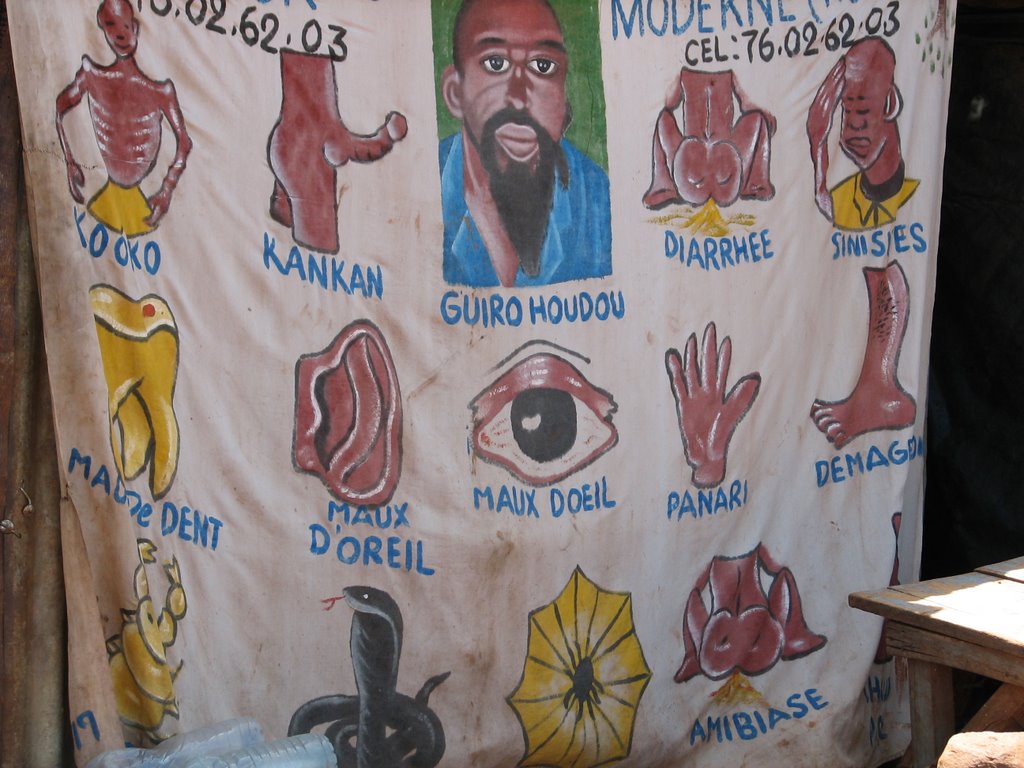
I will start telling you a bit about my experiences down here – be they funny, horrible, interesting or maybe even ‘quirky’ (for lack of a better word). As an example of that, have a look at the following photo taken outside of the office of a local medicine man:
Please note that the clinique is "moderne"...
And what about this woman in the background who is selling bugs (the little black things are big, fried larvae) in a jar to cars passing by her village...
Afterwards, I have decided to write some more of my personal ideas as to why Africa cannot seem to get out of poverty in spite of enormous natural resources, hard-working people and plenty of opportunities in general. I will save all that geo-political, macro-economic babble for last, however, so that readers who could care less can have a chance to bail out before the boring stuff begins. (Or more boring stuff begins – depending how you find this post in general).
The first thing, I wanted to describe, was the unfortunate accident, which me and my driver got involved in on the road between Ouagadougou (capital of BF, known only as ‘Ouaga’) and Bobo-Dioulasso, (where I live). Riding through the bush at a leisurely pace of around 120 km/h, (and yes, that really is considered leisurely around here), whilst we were being taken over by a big 4-wheel drive going about 150. Whilst this take over was being completed, we were passing a tiny petrol station placed in the middle of the bush. At this very moment, at little girl on her bike decided it would be a great time to cross the road without first taking a look over her shoulder, so she turned right in front of our car. After that, things went into slow-motion: My driver displayed lightening-quick reflexes in pulling hard on the steering wheel, and the front of the car missed the girl by a matter of inches. She hammered into the side of the car in stead, and we narrowly missed first the car, which was taking us over and secondly the small petrol station that was on the side of the road. The series of near-misses continued, however, as we went full blast into the bush amazingly without hitting a single tree before coming to a halt in a huge cloud of dust. I had a few seconds to exchange looks with my driver before we got out of the car. None of us had a doubt in our mind that the little girl would be dead as the dodo on the road, but amazingly enough, she came stumbling out of the cloud of dust with “only” a bruised hand and a finger almost ripped of. The bike looked like a metallic version of a long-legged spider after a meeting with a freight train… My driver is Muslim whilst I tend to be of a more Christian persuasion, but we both agreed that god had certainly taken a personal interest in us all that day.
After this we took the girl to a nearby hospital, (oh, I guess I have to add here, that any resemblance to a western-style health establishment was hard to find, except that the doctors wore plastic gloves), where they successfully re-attached the finger and gave the girl the proper inoculations and medicaments, (I off course paid for all of this, to make sure that she would get the proper attention – or get attention at all). We got hold of the girl’s mother, who also arrived.
The whole thing was handled in a calm atmosphere, with no-one blaming us for anything. In fact, the mother was extremely grateful that we had even bothered to stop – much less transport her little girl to hospital… What possibly freaked me out the most was, that the little girl never ushered a word! Not after the accident, not in the car and neither did she cry out when they sowed her finger back on! In fact, the first time that I heard her voice was when her mother called me some days later to tell me, that things were going well with the girl. We have since visited them, and I even have a photo of the little girl:
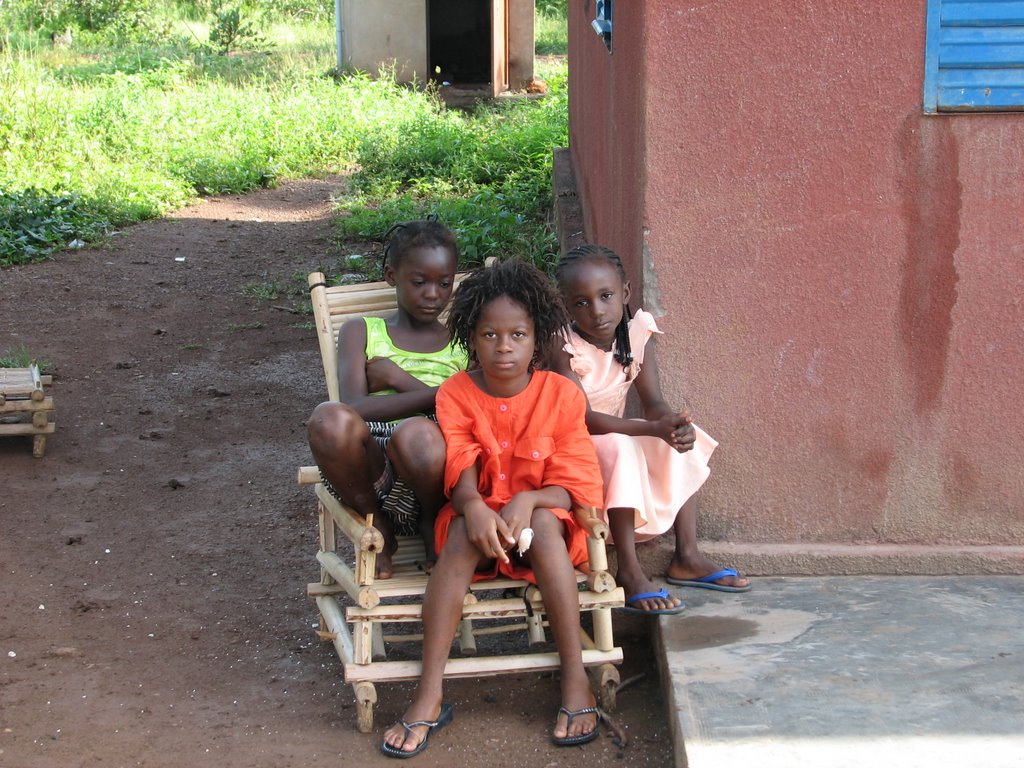
The girl - called Sarah - with her siblings
Since this little encounter - where Certain Death for some reason had taken an unscheduled day off - have tried to make a life for myself here in Bobo. People are friendly, things are reasonably quiet and the work is keeping me on my toes for quite a few hours a day. Not much is lost by working late, though, since there really isn’t much to do in the evenings. The only cinema in Bobo closed a few years back, (because the manager forgot to pay for new films and kept all the income from ticket-sales to himself), and it is not like people have been standing in line to show me other great ways to spend an evening in what ‘Lonely Planet’ calls: ‘The most laid-back place of West Africa’. It gets bloody lonely at times, but I guess I’ll survive on a healthy supply of books, DVDs and hours in the hotel gym. The ‘international community’ of Bobo consist mainly of elderly French men with some very young African partners (more about this in later posts), and Anglophones are rarer than precious metals, so it has not been easy finding people one can hang out with in the scarce spare time available. Finding local friends have so far proven next to impossible as well. Men will ask me for money anywhere between the first and fifth sentence they utter, whilst a lot of the young women will offer me sex – and then ask for money. It is so incredibly frustrating to experience, but to be honest, I can’t really say I blame them. The common consensus here is that any white man walking about is either easy prey or a ticket out of one of the poorest countries in the world… Thus, even if I have politely tried to make locals around me understand that I will in no way function as a newfound gold mine, they always come up with an offer of either some “fantastic business opportunity”, a horrible story about a hospitalised relative who urgently needs a lot of money or – a personal favourite of mine – present me with a prescribed list of drugs (incl. prices) needed to avoid dying this very instant - complete with the doctors signature and stamp. Regarding the latter, the biggest problem is that it seems everyone around here has that exact list with the same stamp and signature – all in all amazing that the whole town hasn’t fallen over dead yet…
As a crazy kind of ‘wake-up’-call from all of this reality, a Coca-Cola representative called me from Denmark on (very) early morning to let me know I had won acompetition after I had written a few lines giving praise to a colleague on their website a few months back. Very ironically, the price was a bunch of coca colas to the whole of my workplace, so whilst I was sitting in Burkina in 42 degrees Celsius, more than a hundred colleagues in Denmark got visited by the Coca-Cola sampling team, (blondes in very good shape, according to my colleagues in DK), who handed out a bunch of cokes for everyone… Having never won a competition in my whole life, I couldn’t help shake my head a bit over the sense of sarcasm displayed by the Almighty in that respect…
I feel like it’s almost an obligation to include a few lines on the more bizarre things, which one keeps experiencing down here, and this time, I would like to describe how freight trains often are used to transport live animals in Africa. Quite a few cows, sheep and chickens are exported from Burkina Faso mainly to the Ivorian capital Abidjan. With the very hot climate down here, it is not possible to butcher the animals here in Burkina and then transport the meat. This means very, very long lines of train wagons departing regularly from Bobo filled with live animals, and one day we got stuck waiting for one of these trains to cross the road. I could have kicked myself for not having my camera with me that day, since it was quite a sight. There were very normal looking cattle cars with open, barred windows filled to capacity with all kinds of cattle, followed by a little less normal cars completely packed with chicken-filled cages stacked from floor to ceiling – wall to wall. The doors were open, I guess to let these poor birds get some air, and the amount of feathers coming out made it look like someone was regularly dropping mini-sized hand grenades inside the wagon. Finally, a lot of open carts with low railings passed us. They were in turn filled to brimming with sheep, standing shoulder to shoulder in the open. Along the railing, quite a few people were placed. First, I though it was freeloaders hitching a ride, but then someone explained to me, that their full job was to be sitting there. Not as a guard against theft, but in stead to make sure that any overturned sheep could be helped back on its feet immediately. Apparently, the sheep will die very quickly, if they are not put back on their feet, so imagine that for a job description: “Sheep lifter”… One could hardly hear the normal sounds of a passing train over the loud protests from all of these animals, and I must admit I don’t really want to know what the survival-rate of especially the chickens is after a few days on the train like that.
In general, the trains down here should really make one be appreciative of our national rail services back home, no matter which short comings they might have!
As warned in the beginning of this post, I will now fire (another) broadside at some of the problems I see being part of limiting the progress of West Africa.
I would love to elaborate a bit on all of the different inputs I have been getting regarding how the governments and official offices work in West Africa, but frankly speaking, I fear putting my honest opinions on public display on a website. This may seem overly cautious, but having learnt my lesson from the extremely paranoid way expatriated French people act regarding criticizing governments or local authorities, I think I will do the same and hold my tongue. Needless to say, that there are very few ACTUAL democracies in Africa, but for a very in-dept analysis of the political history of the different countries down here, I can strongly recommend reading ‘Lonely Planet – West Africa’ that my colleagues kindly bought as a going-away present before my departure. They are certainly not afraid of wording a few truths about the general state of things (or lack of state) down here.
There may be quite a few negative outbursts in this post, but I have spent some time trying to figure out, why it is, that Africa stays so poor. (No, I am not trying to save the world, but I cannot help wondering why this continent is going nowhere). In previous posts, I have already criticised the way the heavily subsidised agricultural products from the western world are being dumped down here and the more than ridiculous way some of the aid-organisations (NGO’s) are handling the project-money spent down here, so I will not spend more time shouting about that. There has to be other and internal reasons as to why Africa is not moving forward, and I decided to try and discover some of them. First and foremost the widespread and – horribly enough – generally ACCEPTED corruption plays a big part. One could argue, that the white man brought the corruption here (it was apparently non-existent in the old African cultures before colonisation), but I must say, that the Africans have certainly embraced it in a way one does not see any other place in the world. Constantly African countries are rated at the very top of all the corruption indexes, and very little progress is seen fighting it. In fact, in quite a few places down here it continues to be on the rise. The general consensus is that corruption is a natural part of everyday African life, so not even in the general public does one see objections towards it. Everyone seems to be looking for a job that would allow them to ask for bribes by everyone else! It is almost impossible to make my mind accept the attitude towards corruption, down here. (Denmark is – according to the latest index – the world’s LEAST corrupt place to live). If I should attempt to describe the attitude in spite of my national ‘handicaps’ in this relation it can be summed up like this:
“Well, corruption is everywhere, there is no way around it, and that will never change. If I should get a chance of blackmailing someone for money that way, I should certainly take it. The best way would be to become a politician, of course”. This is all described very black-and-white (no pun intended), but the longer one stays in Africa, the more one realises the simply staggering level of corruption down here in virtually every layer of society.
Another very important factor, I believe, is the lack of legal reformations down here. Most of the legal systems are based on very old English and French laws, dating back to before the colonisation era and definitely not created to be the legal basis for a modern-day society. Thus, everything here is all “red tape”. Bureaucracy is everywhere and unavoidable, thus creating perfect “breeding grounds” for more corruption. It takes forever to create a company, for instance, thus making sure, that very few people actually try to go through the long and expensive process. As the worst example, it takes 2 years of waiting time to register a simple, one-man company in Somalia, and in Niger it will cost you what equals one annual, average income to complete that same process! All this “red-tape” therefore results in very few companies being made, then again resulting in no VAT or taxes being paid, no organisation of labour being done by the employees (since they don’t actually work for a company) and thus creating no income for the government. I mentioned that corruption feeds on this situation – let me elaborate: If it takes you a year to get your papers through the normal registration procedure, maybe one could “help” the process pick up some speed by offering a bit of “incentive” to the government official managing the waiting list for new companies? If that is too troublesome, quite a few people tend to make a private “arrangement” with the local tax official – making him turn a blind eye to the fact that one is running an unlicensed company. Again a process that prohibits any tax money from actually reaching the state (because all the personal tax ends up in the pocket of the tax collector – yes – it’s like old Nottingham – unfortunately without Robin Hood), and ergo the country stays poor. Apart from this, the family structure down here ensures that everyone is loyal to their family first and to their country later. That goes for all of us, but down here, the family actually takes care of a lot of the things we keep at a national government level in the western world. Thus – it is more important to improve your status in the family than in the country – and corruption’s damage on society is neglected because the focus lies within the family.
I know that a lot of these thoughts have probably been worded, discussed or criticised by a lot of smart people (probably with some sort of degree in economics) – after all I cannot be the first person to notice these things, so I hope no-one accuses me of plagiarism. I still believe, however, that there are more reasons as to why ‘status quo’ seems to be the ruling principle of African developments.
Religion plays a part for sure – I would have liked write a broadside against how Islam is being interpreted by some people around here, but a few drawings of the prophet Mohammed in a Danish newspaper has put me off doing it in English – that will have to wait.
Rather, I would like to comment a bit on the circular way, Africans view their life. In the Western world, we have always thought in a straight line: We are born, we work our way through life trying to improve it and reach goals and then we die. Down here, everything is part of a big circle. Thus, there is no point in moving forward, because we will all end up back at our point of origin. This thought is so very bizarre for westerners that a lot simply cannot accept it, but down here – it’s the order of the day. The problem with the circular way of life is that nothing changes. The tools used for farming during the last several hundred years are not changed or improved – if they were sufficient for the forefathers, they will suffice today. The general mentality simply doesn’t seem to incorporate general wish to optimize, change and improve – and here lies a big part of the reason as to why Africa remains poor. Let me give an example: Back in Aarhus in August, I had lunch with a few colleagues at work. We discussed a new way, that the dairy company had constructed their milk-cartons. The focus point of discussion was a turn-cap opening, which had a few problems. One colleague said that unlike normal cartons, with a turn cap it is not possible to see, whether the carton has been opened or not – which was annoying when one had a big family and a lot of cartons in the fridge. After 6 minutes of discussion, the group had analysed the problem and come up with at least 5 or 6 different approaches as to solving the problems. We had analysed, optimised and solved the problems.
In Africa, they have very fixed ideas about how things you buy at a market should look. Thus, you cannot – in any way – change the way something is wrapped or boxed because the Africans will stop buying it instantly. (This means that all cooking oil sold in Africa continues to be put in orange jerry-cans, because “that’s the way oil should look” – and has looked for about 50 years…). The example may be a bit simplistic, but I hope the message is clear: Africans don’t want change because there is no point. We are all going back to where we came from anyway. (Yes, it’s bizarre for a western mind to accept, I know). It may sound trivial and not very important, but I can assure you, that this way of thinking really holds Africa back.
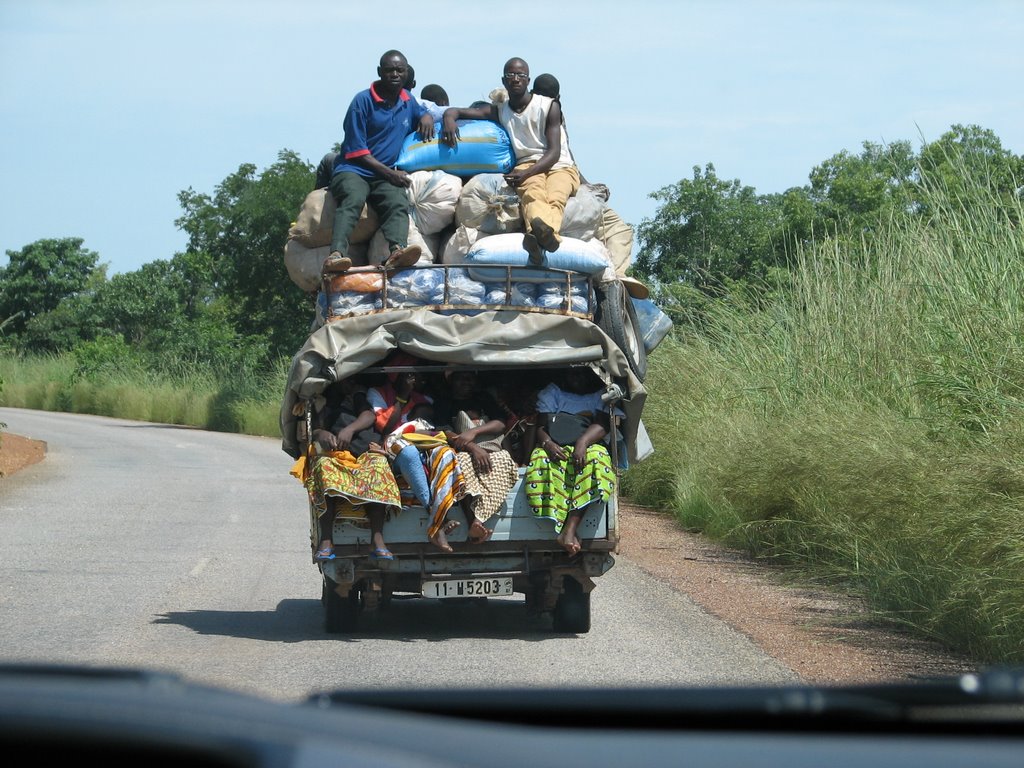
Finally, this post is at an end – I hope the few of you that made it to the end enjoyed it! I couldn't finish without another of my favorite photos of the traffic around here, however, so enjoy:
- someone told me, that a webblog shouldn't only contain long and tedious updates as I have been known to make, so today I thought I'd follow that advice and add a short note.
...or more like a scream for help!
One of the girls working at the hotel, (no Nis, she is working in the restaurant, serving food), persuaded me to let her cut my hair. I was asking for a decent barber around here, and she stepped up, claiming her excellence in the field. Grudingly, I let myself be talked into it, but when she arrived with a standart kitchen-like pair of scissors, I probably should have realised my mistake! After about 5 minutes of work (there was no mirror), I tried to use my calmest voice to ask her, whether she thought it would be a good idea to use a comb or a brush as well, whilst she was cutting - just to get the lenght somewhat even. She replied: "Oh, what a great idea" - genuinely encouraged... She got one, and then the molesting continued.
After about 5 more minutes, she declared, that the job was done. I asked her to use my trimmer to do the edges, and after I had explained to her, what a trimmer actually WAS, she went to work with it with the same enthusiasm, that had formerly filled her use with the pair of old scissors.
The result? Well...if you ever read that episode of Calvin and Hobbes (Steen og Stoffer, red.) where Calvin gives himself a haircut, I think you basically got the idea of how I look at the moment.
...I think I will try and find a barber shop one of these days...
Next update (one of the longer ones) will hopefully follow shortly!
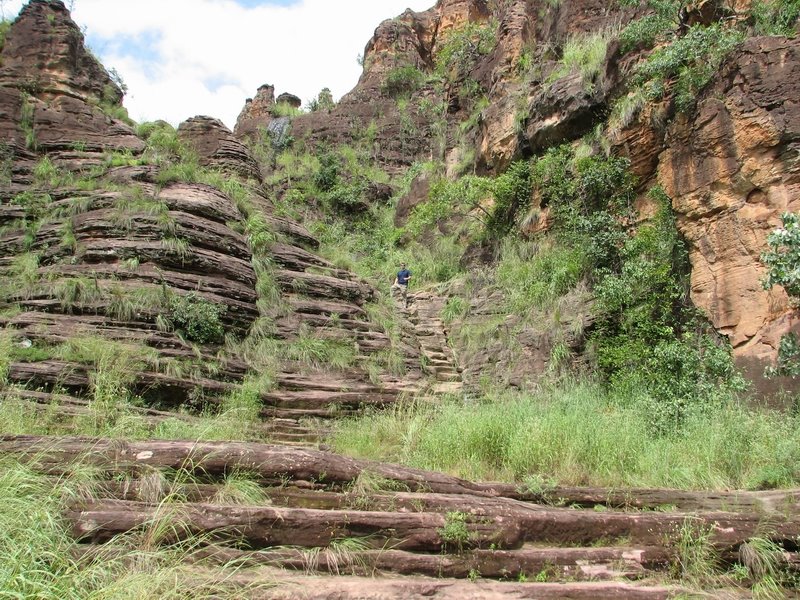
The peaks of Sindou - fantastic views - will post more photos from this wonderous place! (...and yes, I'm the blue dot in the middle!)
Travelling around Vest Africa can prove difficult at times - thank god they put up a sign here...I would have never been aware of the bumpy road, otherwise...
Quite a few people must think: ”That was about time!”, when they see that I have finally updated my little webblog. I have received quite a few very stern requests to do so, anyway, so I guess I can’t delay further. Quite a few things have happened since my last real post back in May. For example, I have decided to begin posting updates in English, in order to keep my friends abroad filled in on what it is I am doing down here in the depths of Africa. (One of my mates in Scotland keeps calling it ”the Congo’s”, and yes – sometimes it feels like it too…). I haven’t planned to quit the Danish ones, but I will have to mix them a bit, I think, since I really won’t have the time to publish 2 versions of each post – (I’m busy (and lazy!) enough as it is). But, to get back to the important stuff, I have now spent the last few weeks in my new home in Burkina Faso (BF). I presume, that it is always in the beginning of an endeavor like mine, that things will feel the most difficult. Anyway, I hope that is the case, because it is indeed not what an American would call a ‘walk in the park’ to move to West Africa (WAF). Before arriving in BF, however, I spent a week in Dakar, Senegal together with two colleagues, in order to prepare our activities there for the season. It was my first trip to Senegal, so naturally I arrived with high hopes of interesting experiences ahead. Dakar is probably the closest, WAF comes to a modern city, and, as far as I understand it, there is not much to do or see in Senegal EXCEPT for Dakar. I hope to get a chance to prove that statement wrong at a later stage, but for this trip, I was ‘confined’ solely to the city of Dakar due to a rather pressed working schedule. The schedule got even tighter than planned because of the slight difficulties our friends in Copenhagen have been experiencing, when it comes to running Airports in the holiday season. I have never in my life seen such chaos as we did upon our arrival in Kastrup Airport. You couldn’t even enter the terminal! Long queues were formed that made the whole building look like long snakes was sprouting out of every door. My colleague spoke to the local security and discovered that not only had the baggage-belt given in – the whole service-staff of the airport had commenced an impromptu strike, just to make the day perfect (and that day was of course the busiest traveling day in Denmark). The security guy said, that they had already stopped several fights in the Terminal! Encouraged by this information, my colleague and I sent happy thoughts to our travel agent, who promised us, that 50 minutes between connecting flights in Lisbon was more than enough… Needless to say it wasn’t, so we got stuck for 24 hours in the Portuguese capital after a debacle of hitherto unseen proportions in the Copenhagen Airport.
Apart from our ridiculously poor hotel, Lisbon proved to be an excellent place to go exploring, and I must recommend it as an ideal destination for a holiday. My colleague and I walked miles and miles and experienced both Cathedrals, military forts, grand plazas and of course the tourist-trap-hospitality of the small restaurants of Lisbon. A great experience – and all in one day.
Thus encouraged, we hoped our flights with the Portuguese Airline TAP would be a milk run. Unfortunately, my distinguished colleague quickly stated that the airline’s name was an abbreviation for: “Take Another Plane” – and I must admit, that he was definitely right. It was like a goat-market being on that flight to Dakar! NO service, microscopic seats, people running around and yelling in the plane at 2 a.m.!. The only time we actually got any attention from the flight staff, was when the tax-free trolley was pulled through the chaos – everyone was almost forced to make a purchase, and if you happened to be asleep as the trolley passed you by, you were shaken awake to make a purchase. I should probably mention, that the staff of TAP is working on commission – thus the more they sell, the more they earn. Jeez!
Arriving in Dakar was also a great experience. There is no visa-requirement in Senegal, but one has to complete a form upon entry into the country. This form was of course not provided by the wonderful TAP, and the airport only supplied a few. Something close to a fight broke out in order to secure one of the scarce forms, but fortunately we were lucky (and violent) enough to get a few – and we entered the customs queue well ahead of the rest of the plane. Then came one of the more “interesting” experiences of WAF: Arriving at the little booth with the customs officer, the only two words we got from him were: “passport” and “Coke!!”. The first word is self-explanatory, but the second may require a bit of comments. It simply meant, that the officer wanted “a little something” for his cola… Think about it – uniformed staff, wanting money to give you your passport back with the required stamps for entry! The scale of corruption in WAF never cease to amaze me! Thus, with a lightened purse we proceeded through the security check point in the airport. All your luggage is scanned upon entry, to make sure that it doesn’t contain anything dangerous. I have no idea why this is done, since they baggage has already been checked ahead of the flight, but the best part was, that no one was actually looking at the screen of the scanner! Nevertheless, we were sharply ordered to put our bags through the x-ray machine?!? Always good fun to try and understand the logic behind a lot of the things and procedures down here, but it certainly isn’t easy, most of the time…
The following days were spent working in Dakar. We didn’t have much time to go exploring, except getting the full tour of the port, which represents the core of our activities in Senegal. I think my Ivorian colleague Marcellin summed up Senegal nicely: “It is like Mali – but clean!”. A very accurate description, actually. It looks like an (almost) modern city, and things seem to work, but basically there isn’t a person there, who wouldn’t like to cheat you of something. Everything is expensive – very expensive even – and peddlers and vendors are extremely aggressive, when you walk the streets and markets. We had a great laugh with one of these street vendors, though. He had just sold ‘beautiful’ set of bags – Louis Vutton (spelling excused) of course – to an American soldier for the tiny sum of 150 Usd. Needles to say: 150 bucks is a virtual FORTUNE in WAF, so we of course asked the guy why on earth anyone would pay that much for a cheap set of copies. The vendor promptly replied: “I don’t sell copies – only ORIGINAL copies!!!”… Well, I guess there’s a certain lady in the U.S. who will be a bit annoyed when her new bags break the first time she uses the zipper… Apart from this, there are great (I’m talking size, here!) slave forts outside the city on an island called Gorée, and we saw that from afar. I would love to go there, but it will have to wait for a later occasion, since our pressed schedule didn’t give us a day to spare. (Thanks again, Copenhagen Airports!).
After all the work and negotiations were done, it was time for me to head for my new home in Burkina Faso. The flight from Dakar to Ouagadougou (the capital of BF) with ‘Air Burkina’ was uneventful save for my constant prayers. The bloody thing was one of the oldest planes, I have seen in my life! The thing still flew though, one should learn to be grateful for the small mercies in life… Besides – Air Burkina only has one plane, as far as I have been told. Thus, one should also be thankful that no president or prime minister needed it, because when that is the case, all flights are of course cancelled until further notice…
After a few days of meetings (and a bit of rest) in the extremely hot Ouagadougou, it was time to go to the town that is going to be a form of “base” for me in the coming months. I am not going to really live anywhere (in the sense that I will not rent a house, hire a housekeeper etc. etc), since I plan to be constantly on the road in Mali, BF, Ghana and also Senegal. I will, however, be spending a lot of time in Bobo-Dioulasso, as my “base” is called. Translated, it means “where the Bobo lives” – ‘the Bobo’ being the biggest local tribe in the area.
Down here, everyone is seen as tribe first, nationality later. This makes a lot of sense, since the colonial powers created the countries down here based on lines drawn with a ruler – not even considering the potential problems that would arise from splitting and combining ethnic groups that were very, very different. No border was made with ANY consideration as to old kingdoms, cultures and peoples – they were made to look ‘nice and square’ on a map… It is no wonder, that Africa has seen so many wars after colonialism did its dirty work down here. The creation of new countries to replace long lasting kingdoms and cultures simply had a devastating effect on the peoples of WAF.
That bit of bile spilled, we can move on to more joyful descriptions of Bobo-Dioulasso – or simply Bobo, as it is normally called. It is Burkina Faso’s second largest town, with approx. 230,000 inhabitants. (This figure must be based on an educated guess, because it is extremely difficult to determine, where the bush ends and Bobo begins… As a general piece of info BF has a total (estimate) of 11 millions citizens. “What’s it like”, people keep asking me, and I keep giving the same answer: “You have to see it to understand it.” I will try to add a few photos, in order to give some sort of idea of what is like to be in Bobo (and a few more to illustrate traffic in WAF – my personal favorite is the one with all the wooden furniture on a small cart!), but pictures alone cannot tell the full story. You really have to experience WAF in all its splendor and misery to get an idea of the enormous cultural, financial and ethnical gap, the relatively short flight from Europe bridges in a matter of 6 hours. Like I have said before: should you wish to ‘give it a go’, I will be happy to help with accommodation, advice and tips for a trip to the worlds greatest continent in so many ways.
In future posts, I will nevertheless try to make an attempt to describe what life is like down here – for the Burkinabe as well as for the Danes!
In trying to avoid repeating former mistakes, I will quit my little update here. I think I am loosing readers on my website, every time I post 14-page updates on the blog, so from now on I’ll try to limit myself.
Much more about the life and travels of Per in West Africa as soon as I get around to it…
I have finally arrived in Bobo, where I am going to be based for the coming months.
We have created a small office in association with a local consultant, and I have now gotten a temporary local cell phone number, on which it should be possible to reach me - also by sms.
The number is: +226 70204733 (NEW!)
Don't hesitate to use it, if you feel like spending a fortune in calling me ;)
I am also online in the office for most of the day, and therefore be reached on msn and/or skype.


.JPG)